In this third week of March with warmer and lighter days bringing hope that the depths of winter are behind us, we saw a jarring juxtaposition of national headlines. On Monday the UK government announced it would cut the UK benefits bill by £5b by 2030 and on Friday Comic Relief asked us to dig deep to support good causes.
I struggle with high profile campaigns like Comic Relief and Children in Need. Whilst it feels a bit Scrooge like to not donate and criticise seemingly well-intentioned endeavours, for me tugging on heart strings and asking people to give their hard-earned money detracts us from why such stark inequalities exist in the first place.
I recently attended an interview for a national post with a remit for shaping policy on the wider determinants of health. I’m not looking for another job but this part-time role seemed too good an opportunity to balance working in a territorial health board, where I have a vested interest in working for the common good across my community and local areas, alongside strategic influence to make things better in the long term. My feedback was positive and all good in the ongoing process of being a reflective practitioner, but I wonder if I was just TOO MUCH. My enthusiasm was overflowing but I didn’t get great non-verbal feedback that this enthusiasm was hitting their sweet spot.
I was asked to talk about taking a public health approach to reducing child poverty. What a gift to have free reign on such an important topic with five influential and powerful leaders in public health.
Child poverty is a topic that should keep us all awake at night, and if it doesn’t maybe we are in the wrong jobs. Poverty has a profound impact on the wellbeing of our future generations. Poverty quashes hope and optimism and grinds people down; it also seeps down through the generations with people brought up in poverty, in turn bringing their own children up in poverty, but of course this inevitable cycle is not one of personal choice. It is unfair and unjust for individuals to not fulfil their potential and have the same chances as someone not living in poverty however we must also remember poverty is detrimental to the wider wellbeing of society.
Nelson Mandela took to the world stage to Make Poverty History in 2005. In his Trafalgar Square speech, he said, amongst other impassioned remarks:
“Like slavery and apartheid, poverty is not natural. It is man-made and it can be overcome and eradicated by the action of human beings.”
In other words, poverty arises from political decisions and how laws are enshrined and enacted – brave people are now saying politically driven determinants of health rather than social determinants of health. I am one of those brave people.
Poverty also arises from political omissions. Mandela was talking about international inequalities between the global south and the global north but what we have seen in those intervening 20 years is further deregulation of the markets to allow the same wealth extraction practices that create global inequalities now become the norm within the UK.
Public health and politics are inextricably linked but as a profession we skirt around this and most certainly do not veer into party politics. This is important to get our heads around, eager academic research and papers convince us of urgency but in this post-truth era we find ourselves in, this may be as good as shouting in the wind.
UK wide, 30% of children live in poverty. In Scotland the figure is markedly lower at 24%, proving that having more money lifts people out of poverty. I am proud to live in a country that values giving our future generations the best start in life with the £26.70 weekly payment per child.
However, we cannot be complacent, we have known about the effects of poverty for a long time and the public health community has rallied around this for more than 25 years. As public health professionals most of us at some point in our career will have used our skills to respond to and mitigate child poverty and we are increasingly being pulled into this response. Invariably this response is “downstream” when poverty is already locked in. Downstream actions to reduce child poverty include things like:
- Free school meals
- Reducing the cost of the school day with free transport or school uniform banks
- Whole family approaches eg money or benefits advice and supporting parents into paid work
- Crisis input eg food provision
Downstream actions might even involve bidding for a Comic Relief grant. However, working in a downstream way, akin to dragging people out the river to stop them from drowning, is always going to be less effective than preventing the problem. So we need to get upstream and eradicate poverty, we need to strengthen the riverbanks and stop people from falling in or alternatively we need to help people become better swimmers. We know this theory from the writings of Paulo Friere and Irving Zola.
Of course it is not an either or when it comes to working upstream or downstream and it would be hard to justify not taking mitigating action. But as there is much that can be done to prevent poverty with a social justice lens, let’s ask ourselves where is our urgency to make things better for the millions of families living in poverty.
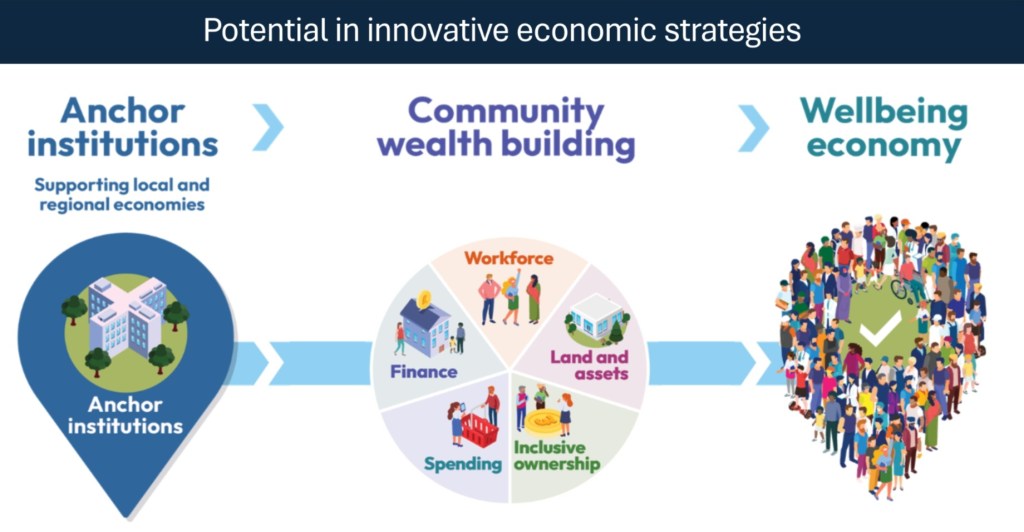
As the week came to an end, a beacon glimmers on the horizon – Thursday 20 March 2025 saw the Community Wealth Building Bill introduced in the Scottish Parliament. Community Wealth Building has the potential to create a more inclusive and sustainable economy and Scotland would be the first country in the world to enact such legislation. Fostering sustainable growth and inward investment; empowering local businesses; and enhanced pay, terms and conditions for workers, could pave the way for a brighter and more prosperous future for all Scots and let all our children flourish. Maybe then we can all sleep a bit easier at night.
 Public Health Artist
Leave a comment