Alison McGrory
1st October 2025
4 minute read
Political leadership
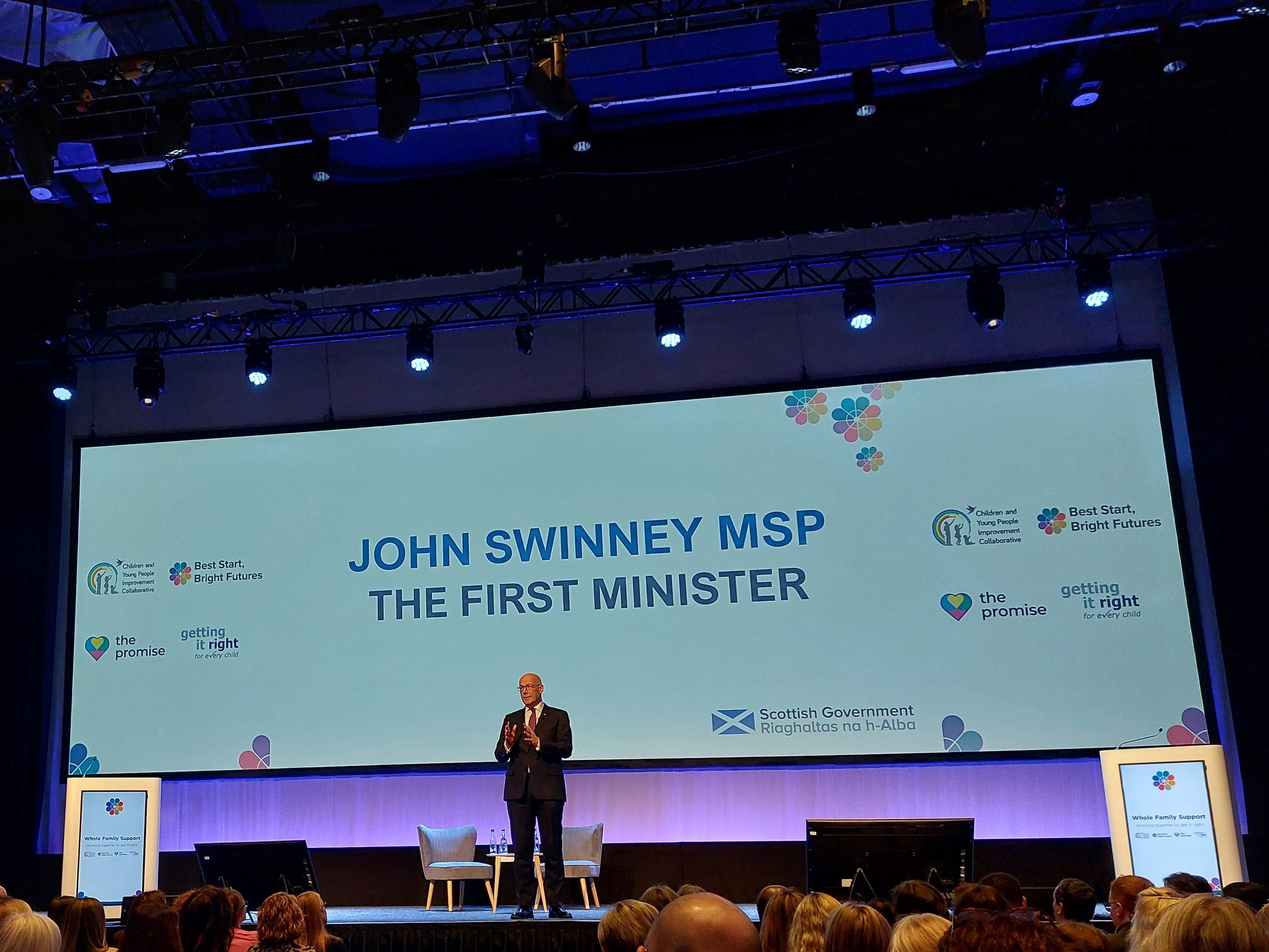
On 25 September 2025, I joined more than 500 people from across Scotland at the national conference on the Whole Family Approach. The event brought together a wide range of voices, united by a shared commitment to tackle one of the most pressing challenges of our time: child poverty. The event was framed not only as a call to action but as a challenge to work differently.
The First Minister, John Swinney, delivered a keynote address that was inspiring if somewhat perplexing. He spoke with conviction about the need to break free from the constraints of traditional systems to unlock the barriers that prevent every child in Scotland from fulfilling their potential. He gave us permission to work differently, acknowledged the limitations of short-term funding and pilot interventions, recognised the vital role of the third sector, and challenged the risk aversion that often paralyses local authorities. He reminded us that statutory responsibilities should not be used as excuses for inaction.
Yet despite this rallying cry, something feels broken in the machinery of government. Civil servants do not appear aligned to this vision. Governance, reporting, performance management and assurance continue to dominate our landscape – rituals of a system that worships at the altar of hard data. Mr Swinney said he is willing to have a conversation about this. We need him to do more than talk.
Is hard data God?
Scotland is trapped in a paradigm that elevates empirical evidence above all else; a consequence of New Public Management, where success is measured in metrics and public servants are judged not by the lives they improve but by the targets they hit. In this world, hard data is God, and we are disciples, endlessly feeding numbers, reports, targets and dashboards, often to the detriment of getting on and doing good work.
During one of the conference breakout sessions, we discussed a pilot project in Dundee involving family liaison officers. These officers work in a person-centred way, supporting people holistically not simply to tick boxes to meet employment targets, but to genuinely improve lives. The most successful workers are those located in communities they themselves belong to, where they know the people, the places and the stories. These workers have a vested interest in supporting people to live well because they themselves are part of the fabric of these communities.
This kind of work doesn’t require complicated datasets held in servers consuming vast quantities of energy and churning out carbon. This work requires trust, relationships and common sense and requires us to value qualitative insight and the lived experience of being human, as much as we value quantitative evidence.
We are often told we need more data to understand what to do and we need to “drill down” into the “granularity” of an issue. This relentless pursuit of more data can be a distraction, but worse than that, it creates delay, risk aversion and maintains an illusion of certainty and control. In this reality I’m not sure I have ever heard anyone say there is enough information to know the answer, because there is always a deeper question waiting in the wings.
Data has its place, can help us learn, refine and improve but it should not be our God. When we elevate hard data above human experience, we dehumanise our work, people become numbers and complex lives are reduced to simplified and measurable, but not necessarily meaningful, outcomes.
The First Minister’s decision to stay and participate in breakout sessions after his speech was a welcome change from usual political performance giving hope that we saw commitment and not rhetoric. But beyond hope is a need for structural change; a need to dismantle systems that prioritise performance management over people.
We can do things differently
Solving child poverty and other deeply rooted challenges takes us beyond the public sector towards all of society, communities must be at the heart of action. Not as passive recipients of services but as equal partners in shaping solutions. Local and place-based working is where transformation will happen, where trust can be built, relationships nurtured, and solutions co-created.
Scotland’s public sector must decide what it is truly here to achieve. If we are serious about reducing child poverty, we must be serious about changing the way we work. That means challenging the dominance of data-driven decision-making. It means valuing lived experience. It means trusting communities. It means embracing complexity. And it means recognising that sometimes, the most powerful interventions are the simplest ones, rooted in relationships, common sense and fuelled by local knowledge.
Let’s stop feeding the God of hard data. Let us start feeding hope, trust and humanity in order to nourish our future generations of Scotland. And we can do this together, not just as public servants, but as neighbours, friends, citizens, collaborators and creators of a better Scotland.

 Public Health Artist
Leave a comment