5 minute read
Telling stories from school
In the mid-1970s, when I was 4 and my sister was 3, my Mum went back to work as a teacher in a small rural school in Argyll and took us with her. From both the perspective of a parent and an employee, this seems quite unbelievable, and I have so many questions. Sadly, she is no longer here to answer them. From what I’ve gleaned, there were very few qualified teachers at the time and the headteacher pleaded with her and helped her to work around looking after us.
I have some very vague and partially formed memories of these days – blackboard dusters so full of chalk that caught the back of your throat when they fell on the floor; chubby crayons for little fingers that scratched the paper and hardly left a mark; brightly coloured nylon jumpers worn instead of school uniform; and a wee boy called Archie with blond curly hair who made such an impression on us that we called our new kitten after him.
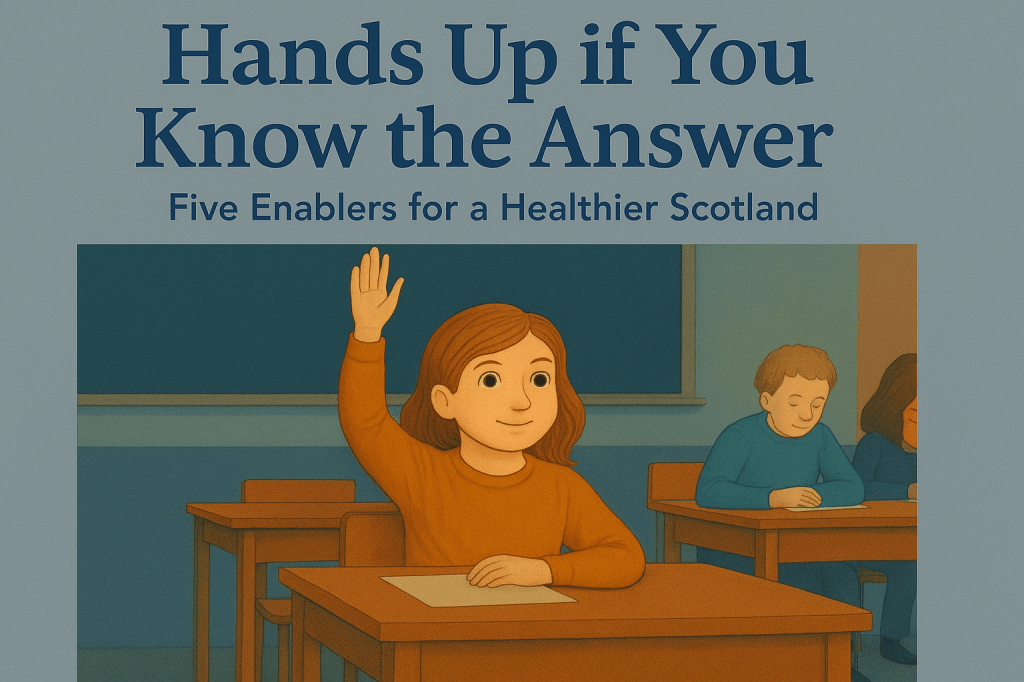
We sat at desks with the other children and joined in with what they were doing and during that time I learned to read. The following year I started school properly and found it was not necessarily an advantage being able to read before everyone else in the class. I have hazy recollections of being that child who always knew the answer, who always put my hand up for questions. That might have been me throughout all my days at primary school where I was forever known as being the daughter of a teacher.
Can you see what I’m doing here, telling a story, sparking your curiosity, enticing you to read on?
Urgent call to action
Nearing the end of 2025, the urgency around the health of our population is palpable. The responding policy landscape this year has been crowded – the Health Service Renewal Framework, the Public Sector Reform Framework, the 10-year Population Health Framework for Scotland. We see common themes in these policies – prevention and early intervention; whole system working; place based and person-centred approaches; effective use of data; and targeted responses to inequalities.
We think we have learned from the failure of the Christie Commission to realise the ambitions of public sector reform and better health for the people of Scotland. The urgency almost translates into an air of we will work harder to nail this challenge. Maybe the frenetic activity since June will begin to percolate into a tangible route map over 2026, for we’re at the start of a 10-year marathon rather than a sprint. Maybe it won’t.
At the moment, I feel like 5-year old me in primary one – I have my hand up, I know the answer, I want the teacher to ask me.
Taking a different path to health creation
So here’s my offer – instead of working harder let’s take a sideways step. Many people have written about the concept of prevention being inherently flawed. Prevention is based on a problem that needs to be solved, meaning you start from what’s wrong. Experience shows us that in complex systems, when we think a problem has been solved, another one rears up and there can even be unintended consequences from preventative aspirations.
Shifting our focus away from preventing health problems would allow us to consider what enables good health and wellbeing – an assets-based approach rather than the deficits lens that lures us time after time. Here are my five enablers of health and wellbeing:
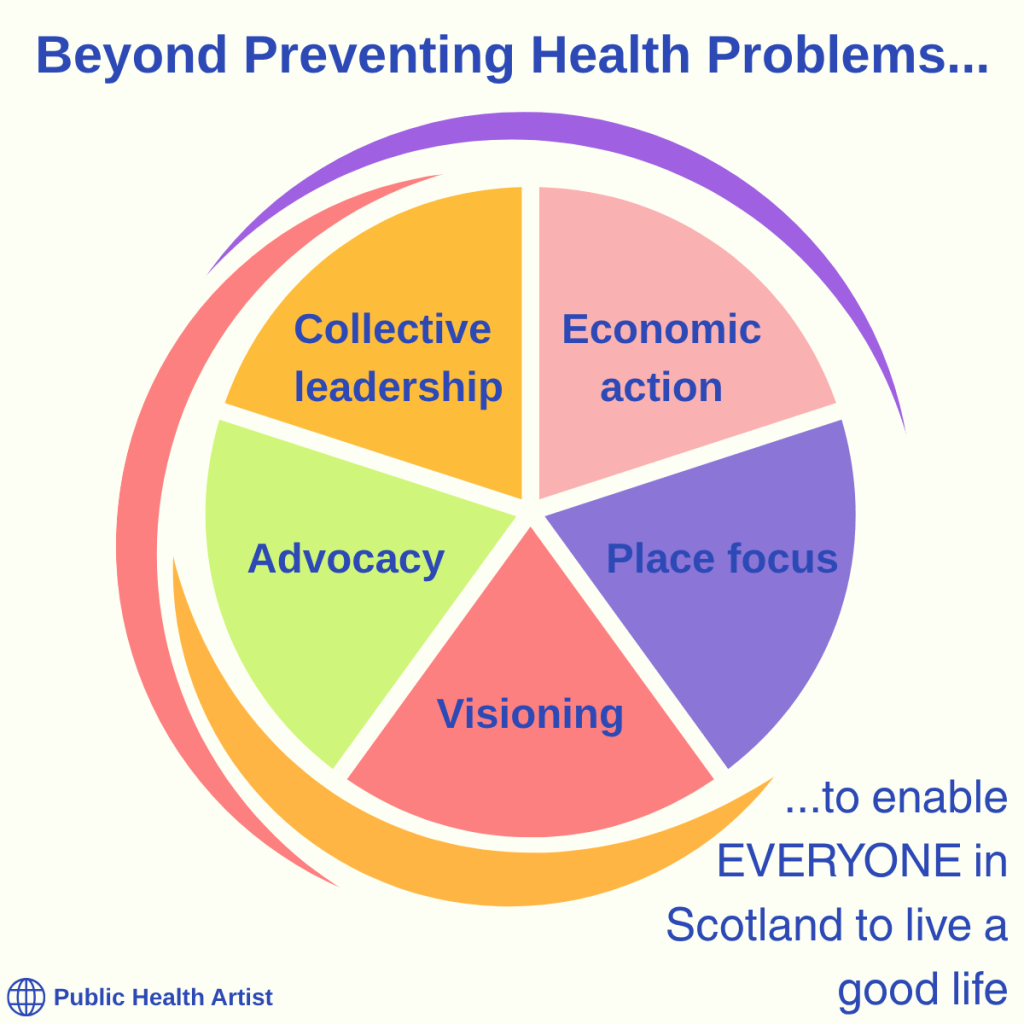
- Collective Leadership
Shift power to local people and embrace radical community development for a better Scotland. Invest in local champions, leave job titles at the door, meet people on their terms, nurture relationships, and build shared aspirations. Leadership should be relational, inclusive, and rooted in trust. - Economy
Ensure everyone has enough money to live a good life by taking bold legislative action to create a fairer, more just Scotland. Use evidence-based approaches like Community Wealth Building and Anchor Institutions to redistribute power and resources locally. - Place-Based Focus
Radically shift from national policy prescriptions to local priorities. People thrive in strong, vibrant communities where protective social capital grows from pride in place and a shared sense of belonging. Local identity and connection are key to wellbeing. - Visioning
Imagine a positive future for Scotland and bring it to life through creativity and storytelling. Appeal to hearts and minds to build hope and belief that a better future is not only possible, but within reach. Let vision guide action. - Advocacy
Align evidence, research, and community aspirations to shape meaningful proposals with the greatest chance of success. Use our collective influence to advocate, lobby, and vote for change as citizens committed to a healthier, fairer Scotland.
The time is right
We already have the key ingredients to help us on the way to realise these five ambitions. Scotland has always been socially minded, and we already have a mature legislative landscape with a Community Empowerment Act and forthcoming Community Wealth Building legislation, as well as progressive taxation and social security policies. We also have a clear sense of belonging, proud national identity and rich natural resources. Scotland can realise the ambitions of a healthier and fairer society for everyone.
I’m now in my 50s in a career I love – school days a dim and distant memory. The 10-year Population Health Framework will likely take me to the end of my paid employment when I will be looking forward to a long and healthy retirement. I sincerely hope to be looking back on 2026, proud of my contribution to create a better Scotland for our future generations.

 Public Health Artist
Leave a comment