5 minute read
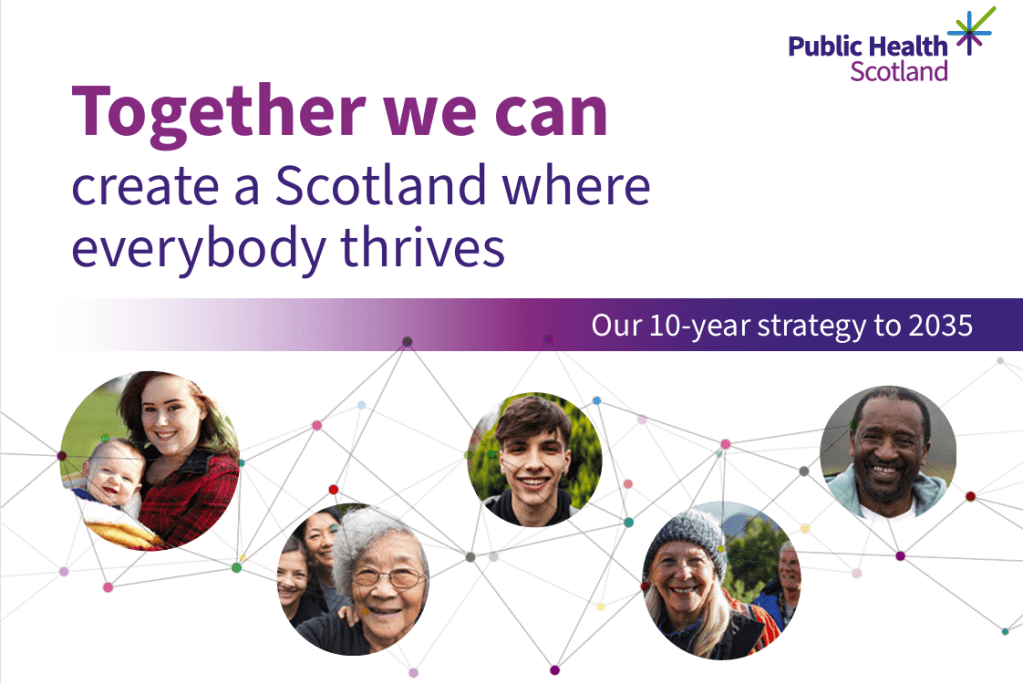
When I first opened Public Health Scotland’s new ten-year strategy, Together We Can, I felt an immediate sense of clarity. It is very readable and visually appealing for a national strategy, and there is a coherent narrative that drew me in. It has an energy that feels intentional. The story is easy to follow, the logic accumulates, and the ambition is expressed in a way that feels both human and grounded. I can imagine people who are not public health professionals picking it up and understanding not only what is being proposed but why it matters. That is no small achievement.
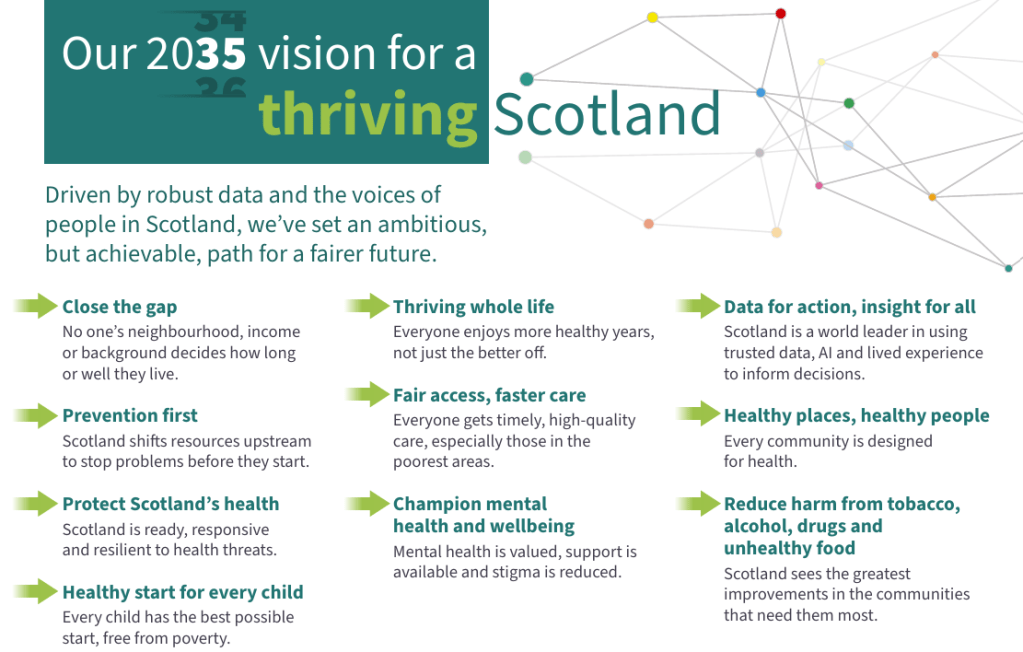
The strategy is wide in scope. It brings together the major issues shaping Scotland’s health and presents them as a connected whole. It sets out clearly what Public Health Scotland intends to do, how it plans to work with partners, and what changes it expects by 2028 and by 2035. That kind of structure gives a feeling of movement. It carries a sense of commitment rather than analysis for its own sake. It also acknowledges that improvement is possible, and that the next decade can be different if we choose to act with purpose.
There is something refreshing about the tone. It describes a nation with serious challenges but does so in a way that is constructive rather than bleak. You can feel the desire to bring people along, to communicate rather than simply instruct. The accessibility of the writing demonstrates real care for the reader, which in itself is a quiet act of public health.
And yet, as uplifting as the ambition is, 2035 is not far away. Nine years is a short period of time in the life of a health system. It is even shorter when we consider the depth and persistence of Scotland’s inequalities. The strategy commits to reducing the gap between people who are well off and those who are not and increasing life expectancy overall by one year. While that is absolutely the right ambition, achieving it will require more than bold words. Inequalities are shaped by forces that run deep. They do not respond neatly to ten-year plans, no matter how well designed those plans are.
As I read further, I became aware of what is not said. One of the first gaps that stood out was the absence of systems thinking and complexity science. Many of the challenges highlighted in the strategy are problems we have been grappling with for decades. They are fluid and interdependent. Wicked problems never sit still and never allow for tidy solutions. Without naming this complexity, the strategy risks giving the impression that progress will follow a straightforward and linear path.
I also found myself looking for stronger recognition of democracy and power. On page 35, the strategy speaks about empowering people with a focus largely on individual agency, particularly healthier choices. This does matter, but it is only one part of the story. Real empowerment is democratic in the fullest sense. It is collective. It is about communities shaping the conditions that influence their health, not only precariously navigating choices within those conditions. When people organise, influence local priorities, and contribute to decision making, they exercise a form of power that extends far beyond individual behaviour change. Public health has always been at its strongest when it recognises this collective dimension.
This is why the strategy’s use of the term co-design feels narrow. Co-design involves including people in shaping ideas, but democracy in public health invites a deeper shift. True co-production means communities are involved throughout, from commissioning services to delivering them to defining what success looks like. It is co-production that redistributes power. It asks institutions to step back and share control rather than consult on it. This connection between democracy and co-production is crucial, and I found myself thinking about it again when I reached the small bullet point on page 37 which encourages us to be bold in prioritising action that will benefit the public, as stewards of public funds. The wording is ambiguous, but I am intrigued by the possibility that it could mean something radical. What if the public themselves were seen as the stewards of their own outcomes and of the resources available to support them. That idea would take co-production into new terrain that is genuinely democratic.
Other topics felt light. Place and climate, for example, could have been treated with greater depth. Working in a rural area has shown me how different the public health landscape looks depending on geography, population size, infrastructure, and relationships. Distance matters. Transport matters. Informal networks and social capital matter. Workforce sustainability matters. Place, climate and economy could have been brought together with more cohesion under the banner of a local wellbeing economy and the potential benefits of the Community Wealth Building Act.
Community Planning Partnerships have an important role for action on all of this, and Together We Can recognises these bodies as a powerful mechanism for improving health and wellbeing. I look forward to informing this direction of travel because their potential is not being realised – see my point on democracy above!
The omission that surprised me most was of trauma, although mental health is mentioned more than once. Scotland has invested heavily in trauma informed practice, and we know how profoundly trauma shapes health over the life course. To leave it unmentioned creates a silence that feels out of step with our collective understanding of adversity and its effects.
Despite these reflections, I finish reading the strategy with a sense of hope. Its strengths are real, and it sets a direction that many of us can gather around. Perhaps its greatest contribution is the space it opens for deeper conversations about complexity, democracy, trauma, rurality, food systems and the need for more emergent approaches to change. If we can hold uncertainty with more confidence and trust in the insight and creativity of communities, we may find solutions that no strategy could fully predict.
Perhaps my point is we cannot hold all the answers nor can we expect one strategy to lay them out entirely. Indeed, as we move into Scotland’s pre-election period at lightning speed, the agency falls to all of us citizens of Scotland to think deeply about what kind of country we want to live in and leave for our children and grandchildren.
Together We Can marks a contribution to that journey, but there is even more hope to be had from involving everyone in Scotland in developing a clear vision for a flourishing Scotland.
 Public Health Artist
Leave a comment